
 ,
Hary Andrianarimanana Razafindramiandra,
Mbolatiana Anjarasoa Luc Ralaivelo,
Joseph Lucien Radaorolala Zafimanjato,
Tahiry Razakarimanana,
Veroniaina Raharimboangy,
José Elysé Rajoeliarivony
,
Hary Andrianarimanana Razafindramiandra,
Mbolatiana Anjarasoa Luc Ralaivelo,
Joseph Lucien Radaorolala Zafimanjato,
Tahiry Razakarimanana,
Veroniaina Raharimboangy,
José Elysé Rajoeliarivony
Radon is the radioactive gas naturally present in the environment produced by natural radioactive decay of uranium-238. It is uncolored and inodorous and present in outdoor air as well as in dwelling spaces. In nine (09) regions of Madagascar, radon study was carried out for indoor radon concentration measurement in 62 dwellings spread. The aim of this study is to compare the indoor internal exposure due to Radon inhalation. AphaGuard and SARAD equipment were used. The radon concentration and the annual effective dose vary respectively from (4.37 ± 1.74) Bq.m-3 to (77.80 ± 4.51) Bq.m-3 with average value of (31.04 ± 7.78) Bq.m-3 and from (0.14 ± 0.05) mSv.y-1 to (2.45 ± 0.14) mSv.y-1 with average value of (0.98 ± 0.18) mSv.y-1. The average value of Lung Cancer Case (LCC) per year and per million persons was found at 17.62. The average radon concentration is lower than the WHO, UNSCEAR 2000, and GSR Part N°.3 Public limit value, however, its contribution to the total exposition to the population is significant. It has been found that all the obtained results during this works vary across regions. The Region of Vakinankaratra represents the highest effective average value of annual high effective dose and radon concentration due to high uranium potential of this region. Analanjirofo and Antsinanana regions represent the lowest annual effective dose and radon concentration due to the abundance of Th-232 concentration than Uranium in these regions.
| Published in | American Journal of Physics and Applications (Volume 13, Issue 2) |
| DOI | 10.11648/j.ajpa.20251302.13 |
| Page(s) | 31-37 |
| Creative Commons |
This is an Open Access article, distributed under the terms of the Creative Commons Attribution 4.0 International License (http://creativecommons.org/licenses/by/4.0/), which permits unrestricted use, distribution and reproduction in any medium or format, provided the original work is properly cited. |
| Copyright |
Copyright © The Author(s), 2025. Published by Science Publishing Group |
Radon, Environment, Radioactivity, Effective Dose, Public
Region | Numbers of radon measurement | Radon Concentration [Bq.m-3] | Annual effective Dose [mSv.y-1] | LCC × 10-6 | ||||
|---|---|---|---|---|---|---|---|---|
Min | Max | Average | Min | Max | Average | |||
Sofia et Diana | 6 | 56 ± 17 | 78 ± 15 | 67 ± 16 | 1.77 ± 0.54 | 2.46 ± 0.47 | 2.11 ± 0.50 | 37.98 |
Atsimo Andrefana | 12 | 4 ± 0.10 | 63 ± 11.80 | 22.25 ± 8.59 | 0.13 ± 0.00 | 1.99 ± 0.37 | 0.70 ± 0.27 | 12.04 |
Atsinanana | 4 | 5 ± 0.50 | 14 ± 6.00 | 9.5 ± 3.14 | 0.16 ± 0.02 | 0.44 ± 0.19 | 0.30 ± 0.10 | 5.40 |
Analanjirofo | 7 | 1.20 ± 0.07 | 8.10 ± 3.10 | 4.37 ± 1.74 | 0.04 ± 0.00 | 0.26 ± 0.10 | 0.14 ± 0.05 | 2.52 |
Ihorombe | 5 | 1.6 ± 0.09 | 32 ± 5.23 | 12.04 ± 2.24 | 0.05 ± 0.00 | 1.01 ± 0.16 | 0.38 ± 0.07 | 6.84 |
Anosy | 6 | 13 ± 0.89 | 70 ± 13.00 | 36.17 ± 6.12 | 0.41 ± 0.03 | 2.21 ± 0.41 | 1.14 ± 0.19 | 20.52 |
Vakinakaratra | 9 | 10 ± 1.00 | 295.63 ± 10.63 | 77.80 ± 4.51 | 0.32 ± 0.03 | 9.32 ± 0.34 | 2.45 ± 0.14 | 44.10 |
Analamanga | 13 | 8.1 ± 0.50 | 44 ± 2.00 | 19.18 ± 3.90 | 0.26 ± 0.02 | 1.9 ± 0.37 | 0.61 ± 0.12 | 10.98 |
Average | 62 | 31.04 ± 5.78 | 0.98 ± 0.18 | 17.62 | ||||
Min | 4.37 ± 1.74 | 0.14 ± 0.05 | 5.40 | |||||
Max | 77.80 ± 4.51 | 2.45 ± 0.14 | 44.10 | |||||
CEA | Commissariat à l’Energie Atomique |
GPS | Global Positioning System |
GSR | General Safety Requirements |
IAEA | International Atomic Energy Agency |
ICPR | International Commission on Radiological Protection |
INSTN | Institut National des Sciences et Techniques Nucléaires |
LCC | Lung Cancer Case |
OMNIS | Office des Mines Nationales et des Industries Stratégiques |
UNSCEAR | United Nations Scientific Committee on the Effects of Atomic Radiation |
WHO | World Health Organization |
| [1] | COMMISSION CANADIENNE DE SURETE NUCLEAIRE. (2010). Le radon au sein du secteur canadien de l’uranium. Consulté le 30 septembre 2010. |
| [2] | INTERNATIONAL ATOMIC ENERGY AGENCY (IAEA) “Protection of the Public against Exposure Indoors due to Radon and Other Natural Sources of Radiation”. IAEA Safety Standards, No. SSG-32, VIENNA, 2015. |
| [3] | SAPHYMO GMBH. «AlphaGUARD, Portable Radon Monitor, User Manuel», ALGU_Manual_2012-08_E.doc. |
| [4] | GOURONNEC, A. M. (1995). Modélisation et étude expérimentale du comportement du radon et de ses descendants dans une enceinte confinée. Application à une habitation. Paris, 135p. |
| [5] | ALMAYAHI, B. A., TAJUDDIN, A. A., JAAFAR, M. S, (2014). Calibration technique for a CR-39 detector for soil and water radon exhalation rate measurements. Radioanal Nucl Chem 301: 133–140. |
| [6] | ALMAYAHI B. A., ASAAD K. ALSAEDI, ALI K. ALSAEDI, A. H. ALASADI, AZHAR S. ALI, RAAD. O. HUSSEIN, HAYDER. H. HUSSAIN, 2014. Ceramic Rn222 exhalation rates from different countries, International Journal of Scientific and Engineering Research, 5; 2162- 2164. |
| [7] | H. MANSOUR, ET AL., "Measurement of indoor radon levels in Erbil capital by using solid state nuclear track detectors, Radiation measurements., 40, 544-547, 2005. |
| [8] | S. KANSAL, ET AL., Life time fatality risk assessment due to variation of indoor radon concentration in dwellings in western Haryana, India, Applied Radiation and Isotopes., 70, 1110-1112, 2012. |
| [9] | JOURNAL OFFICIEL DE LA REPUBLIQUE DE MADAGASCAR «Décret N°2002-1199 fixant les principes généraux de la protection contre le rayonnement ionisant», mai 2003. P. 1514-1540. |
| [10] | UNSCEAR (2000). “Sources and biological effects of ionizing radiation”. Report to general assembly with scientific annexes. United Nations, New York, 2000. |
| [11] | WORLD HEALTH ORGANIZATION (2009). “Handbook on Indoor Radon, a Public Health Perspective”, Geneva, Switzerland. |
| [12] | INTERNATIONAL ATOMIC ENERGY AGENCY (IAEA), “Radiation Protection and Safety of Radiation Sources. International Basic Safety Standards”, GSR Part 3, Vienna, 2014. |
| [13] | INTERNATIONAL COMMISSION ON RADIOLOGICAL PROTECTION. “Protection Against Radon-222 at Home and Works”. ICRP Publication 1993, pp 65. |
| [14] | INTERNATIONAL ATOMIC ENERGY AGENCY (IAEA), «Radiation Protection of the Public and the Environment», IAEA Safety Standards Series No. GSG-8, VIENNA, 2018. |
| [15] | INTERNATIONAL ATOMIC ENERGY AGENCY (IAEA), «Design and Conduct of Indoor Radon Surveys», Safety Reports Series no. 98, VIENNA, 2018. |
| [16] | Réglementation en Radioprotection à Madagascar, «LOI n° 97-041» du 02 janvier 1998. |
APA Style
Randriamora, T. H., Razafindramiandra, H. A., Ralaivelo, M. A. L., Zafimanjato, J. L. R., Razakarimanana, T., et al. (2025). Comparison of Public Indoor Internal Exposure from Radon-222 Inhalation in the Different Dwellings of 09 Regions of Madagascar. American Journal of Physics and Applications, 13(2), 31-37. https://doi.org/10.11648/j.ajpa.20251302.13
ACS Style
Randriamora, T. H.; Razafindramiandra, H. A.; Ralaivelo, M. A. L.; Zafimanjato, J. L. R.; Razakarimanana, T., et al. Comparison of Public Indoor Internal Exposure from Radon-222 Inhalation in the Different Dwellings of 09 Regions of Madagascar. Am. J. Phys. Appl. 2025, 13(2), 31-37. doi: 10.11648/j.ajpa.20251302.13
AMA Style
Randriamora TH, Razafindramiandra HA, Ralaivelo MAL, Zafimanjato JLR, Razakarimanana T, et al. Comparison of Public Indoor Internal Exposure from Radon-222 Inhalation in the Different Dwellings of 09 Regions of Madagascar. Am J Phys Appl. 2025;13(2):31-37. doi: 10.11648/j.ajpa.20251302.13
@article{10.11648/j.ajpa.20251302.13,
  author = {Tiana Harimalala Randriamora and Hary Andrianarimanana Razafindramiandra and Mbolatiana Anjarasoa Luc Ralaivelo and Joseph Lucien Radaorolala Zafimanjato and Tahiry Razakarimanana and Veroniaina Raharimboangy and José Elysé Rajoeliarivony},
  title = {Comparison of Public Indoor Internal Exposure from Radon-222 Inhalation in the Different Dwellings of 09 Regions of Madagascar
},
  journal = {American Journal of Physics and Applications},
  volume = {13},
  number = {2},
  pages = {31-37},
  doi = {10.11648/j.ajpa.20251302.13},
  url = {https://doi.org/10.11648/j.ajpa.20251302.13},
  eprint = {https://article.sciencepublishinggroup.com/pdf/10.11648.j.ajpa.20251302.13},
  abstract = {Radon is the radioactive gas naturally present in the environment produced by natural radioactive decay of uranium-238. It is uncolored and inodorous and present in outdoor air as well as in dwelling spaces. In nine (09) regions of Madagascar, radon study was carried out for indoor radon concentration measurement in 62 dwellings spread. The aim of this study is to compare the indoor internal exposure due to Radon inhalation. AphaGuard and SARAD equipment were used. The radon concentration and the annual effective dose vary respectively from (4.37 ± 1.74) Bq.m-3 to (77.80 ± 4.51) Bq.m-3 with average value of (31.04 ± 7.78) Bq.m-3 and from (0.14 ± 0.05) mSv.y-1 to (2.45 ± 0.14) mSv.y-1 with average value of (0.98 ± 0.18) mSv.y-1. The average value of Lung Cancer Case (LCC) per year and per million persons was found at 17.62. The average radon concentration is lower than the WHO, UNSCEAR 2000, and GSR Part N°.3 Public limit value, however, its contribution to the total exposition to the population is significant. It has been found that all the obtained results during this works vary across regions. The Region of Vakinankaratra represents the highest effective average value of annual high effective dose and radon concentration due to high uranium potential of this region. Analanjirofo and Antsinanana regions represent the lowest annual effective dose and radon concentration due to the abundance of Th-232 concentration than Uranium in these regions.
},
 year = {2025}
}
TY  - JOUR
T1  - Comparison of Public Indoor Internal Exposure from Radon-222 Inhalation in the Different Dwellings of 09 Regions of Madagascar

AU  - Tiana Harimalala Randriamora
AU  - Hary Andrianarimanana Razafindramiandra
AU  - Mbolatiana Anjarasoa Luc Ralaivelo
AU  - Joseph Lucien Radaorolala Zafimanjato
AU  - Tahiry Razakarimanana
AU  - Veroniaina Raharimboangy
AU  - José Elysé Rajoeliarivony
Y1  - 2025/04/17
PY  - 2025
N1  - https://doi.org/10.11648/j.ajpa.20251302.13
DO  - 10.11648/j.ajpa.20251302.13
T2  - American Journal of Physics and Applications
JF  - American Journal of Physics and Applications
JO  - American Journal of Physics and Applications
SP  - 31
EP  - 37
PB  - Science Publishing Group
SN  - 2330-4308
UR  - https://doi.org/10.11648/j.ajpa.20251302.13
AB  - Radon is the radioactive gas naturally present in the environment produced by natural radioactive decay of uranium-238. It is uncolored and inodorous and present in outdoor air as well as in dwelling spaces. In nine (09) regions of Madagascar, radon study was carried out for indoor radon concentration measurement in 62 dwellings spread. The aim of this study is to compare the indoor internal exposure due to Radon inhalation. AphaGuard and SARAD equipment were used. The radon concentration and the annual effective dose vary respectively from (4.37 ± 1.74) Bq.m-3 to (77.80 ± 4.51) Bq.m-3 with average value of (31.04 ± 7.78) Bq.m-3 and from (0.14 ± 0.05) mSv.y-1 to (2.45 ± 0.14) mSv.y-1 with average value of (0.98 ± 0.18) mSv.y-1. The average value of Lung Cancer Case (LCC) per year and per million persons was found at 17.62. The average radon concentration is lower than the WHO, UNSCEAR 2000, and GSR Part N°.3 Public limit value, however, its contribution to the total exposition to the population is significant. It has been found that all the obtained results during this works vary across regions. The Region of Vakinankaratra represents the highest effective average value of annual high effective dose and radon concentration due to high uranium potential of this region. Analanjirofo and Antsinanana regions represent the lowest annual effective dose and radon concentration due to the abundance of Th-232 concentration than Uranium in these regions.

VL  - 13
IS  - 2
ER  -
Department of Dosimetry and Radiation Protection, National Institute of Nuclear Sciences and Techniques, (INSTN- Madagascar), Antananarivo, Madagascar; Faculty of Science and Technology, University of Toamasina, Toamasina, Madagascar
Department of Dosimetry and Radiation Protection, National Institute of Nuclear Sciences and Techniques, (INSTN- Madagascar), Antananarivo, Madagascar
Department of Dosimetry and Radiation Protection, National Institute of Nuclear Sciences and Techniques, (INSTN- Madagascar), Antananarivo, Madagascar
Department of Dosimetry and Radiation Protection, National Institute of Nuclear Sciences and Techniques, (INSTN- Madagascar), Antananarivo, Madagascar; Direction of Radiological Safety and Nuclear Security, National Institute of Nuclear Sciences and Techniques (INSTN- Madagascar), Antananarivo, Madagascar
Department of Dosimetry and Radiation Protection, National Institute of Nuclear Sciences and Techniques, (INSTN- Madagascar), Antananarivo, Madagascar
Department of Dosimetry and Radiation Protection, National Institute of Nuclear Sciences and Techniques, (INSTN- Madagascar), Antananarivo, Madagascar
Department of Dosimetry and Radiation Protection, National Institute of Nuclear Sciences and Techniques, (INSTN- Madagascar), Antananarivo, Madagascar
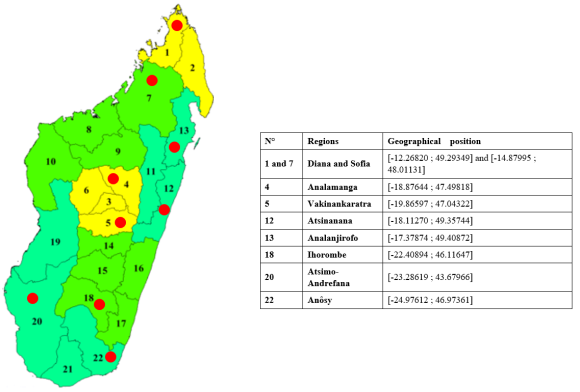
Figure 1. Indoor Radon concentration measurement in 9 Regions of Madagascar.
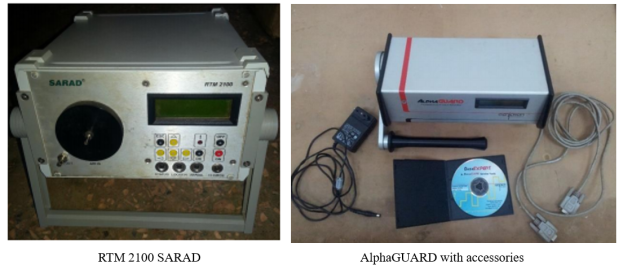
Figure 2. Radon Detection Equipment.
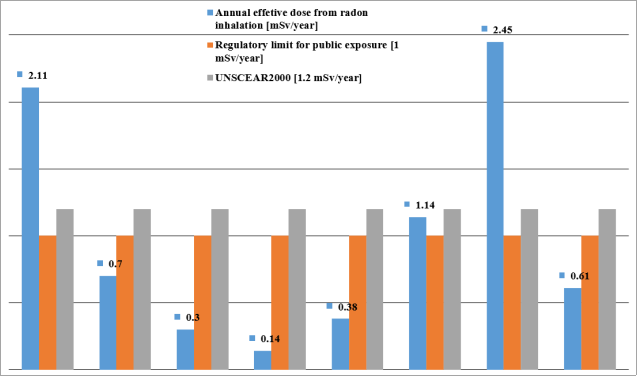
Figure 3. Annual effective dose efficace due to radon inhalation in the 9 regions of Madagascar.
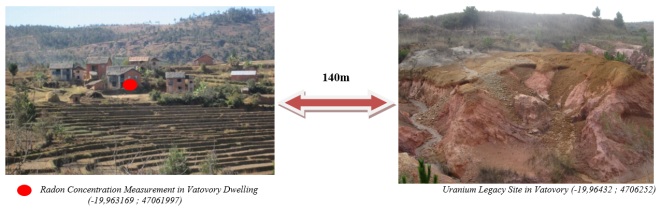
Figure 4. Distance between indoor radon Concentration in Vatovory and Uranium Legacy Site in Vatovory in the region of Vakinankaratra.
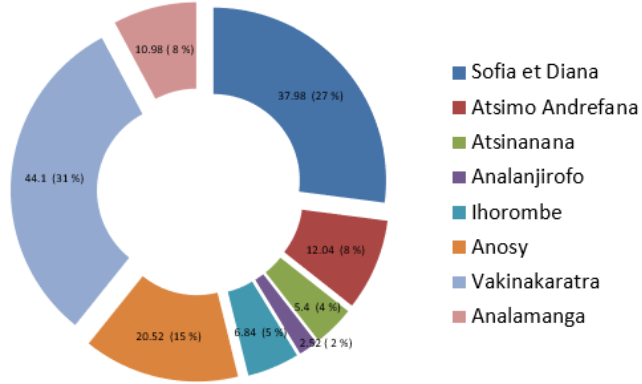
Figure 5. Lung Cacer Case per year per million person in the 09 regions of Madagascar (LCC).

Information


 Share This Article
 Twitter
 Linked In
 Facebook
 Copy
Copy Download